If I had to pick the single biggest shift in how we work at Alpha Bits during 2025, it wouldn't be a new model or a bigger context window. It was the moment our AI tools stopped waiting for us to type and started doing things on their own.
That's the chatbot-to-agent transition in one sentence. But the details matter, because this shift changed how we staff projects, how we price services, and what we tell clients is possible.
What "Agent" Actually Means (Without the Hype)
For most of 2024 and early 2025, our AI workflow looked like this: human has a task, human writes a prompt, AI returns a result, human copies it somewhere useful. The AI was fast and often good, but every step still needed a human sitting at a keyboard, orchestrating each move.
By late 2025, the tools caught up to the idea. An agent isn't just a chatbot with a better prompt — it's software that can take a goal, break it into steps, use external tools (email, databases, APIs), and execute those steps with minimal human oversight.
The difference in practice: instead of me drafting a customer response with AI help, then manually pasting it into the CRM, then logging a follow-up — an agent reads the incoming message, classifies the intent, drafts a response, queues it for my approval, and pre-logs the interaction. I click "approve." That's it.
Where We Actually Deployed Agents in 2025
The AI Receptionist
Our AI Receptionist is probably the clearest example. Four AI agents — Tim, Clara, Brian, Kamala — each with a distinct personality, handling website inquiries 24/7. They don't just answer questions. They capture lead information through natural conversation, log every interaction into a CRM, and escalate to humans when they hit the boundary of what they know.
We built this on Groq for inference speed and SvelteKit for the API layer. The agents follow a four-pillar architecture: Soul, Objectives, Knowledge, and Guardrails. The guardrails matter most — without them, you get an agent that confidently invents menu items or promises discounts that don't exist.
Brian During the Tết Attack
During Vietnamese New Year 2026, our eCommerce servers got hit by a botnet while the entire team was on holiday. Brian — our security-focused AI agent — was deployed directly onto the server to parse logs in real time. It identified the malware variant, flagged the vulnerable port, and helped us patch the firewall rules within hours. A human team working through holiday logs would have taken significantly longer.
The Shopee Workshop
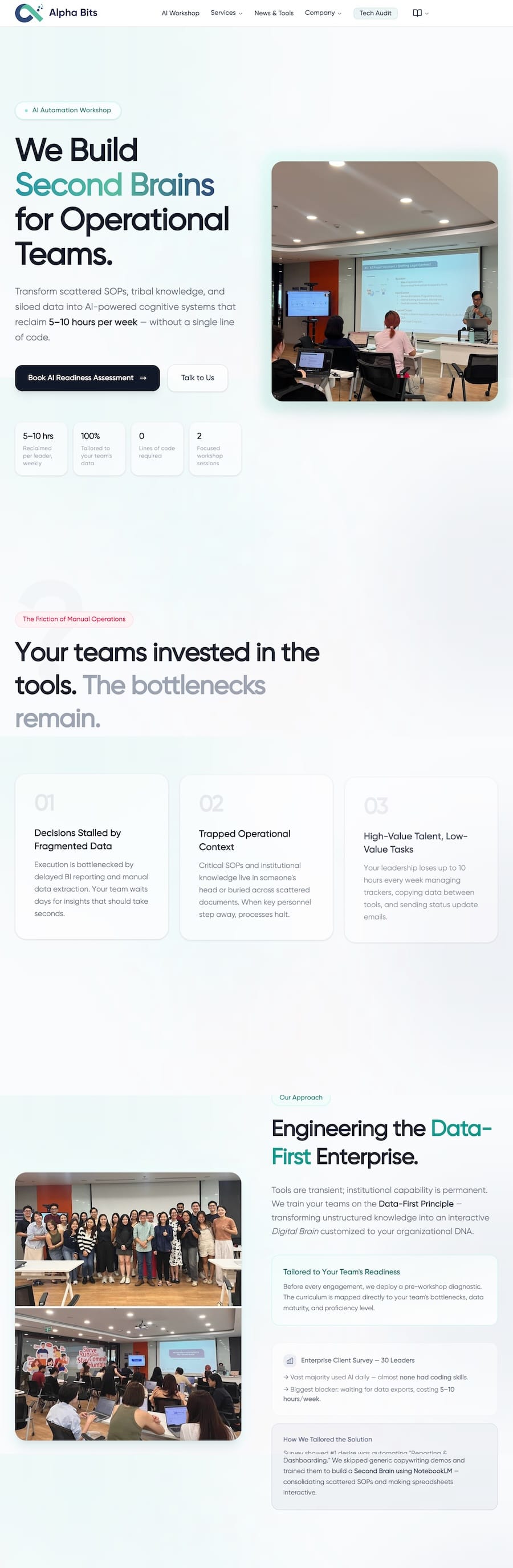
When we ran an AI workshop for Shopee's operational leaders, the pre-workshop survey revealed exactly this gap. Most participants used AI daily — for drafting, summarising, translating. But they were stuck in prompt-response mode. The workshop taught them to connect AI to their actual tools: Google Forms → Node-RED → Telegram notifications → CRM logging. The shift from "AI helper" to "AI workflow" happened in a single morning session.
What Changed for Small Teams
For SMEs and small consultancies like ours, the agent shift hit differently than it did for enterprises.
We went from a 20-25 person ERP development team in late 2024 to a three-person team that delivers the same calibre of work. That's not a hypothetical — that's our actual headcount. A project manager, a fullstack developer, and a QA engineer. AI agents fill the other seats: code review, test generation, documentation, deployment orchestration.
But — and I keep stressing this to clients — that only works because our data infrastructure and processes were already solid. Agents pulling from messy, undocumented systems produce confident garbage. The data-first principle isn't optional when you're handing work to autonomous software.
The Question for 2026
The question for operational leaders isn't "How can we use AI to work faster?" anymore. It's more specific than that: which workflows in your business are repetitive, well-documented, and have clear success criteria? Those are your agent candidates.
Start there. Not with the technology. With the process.