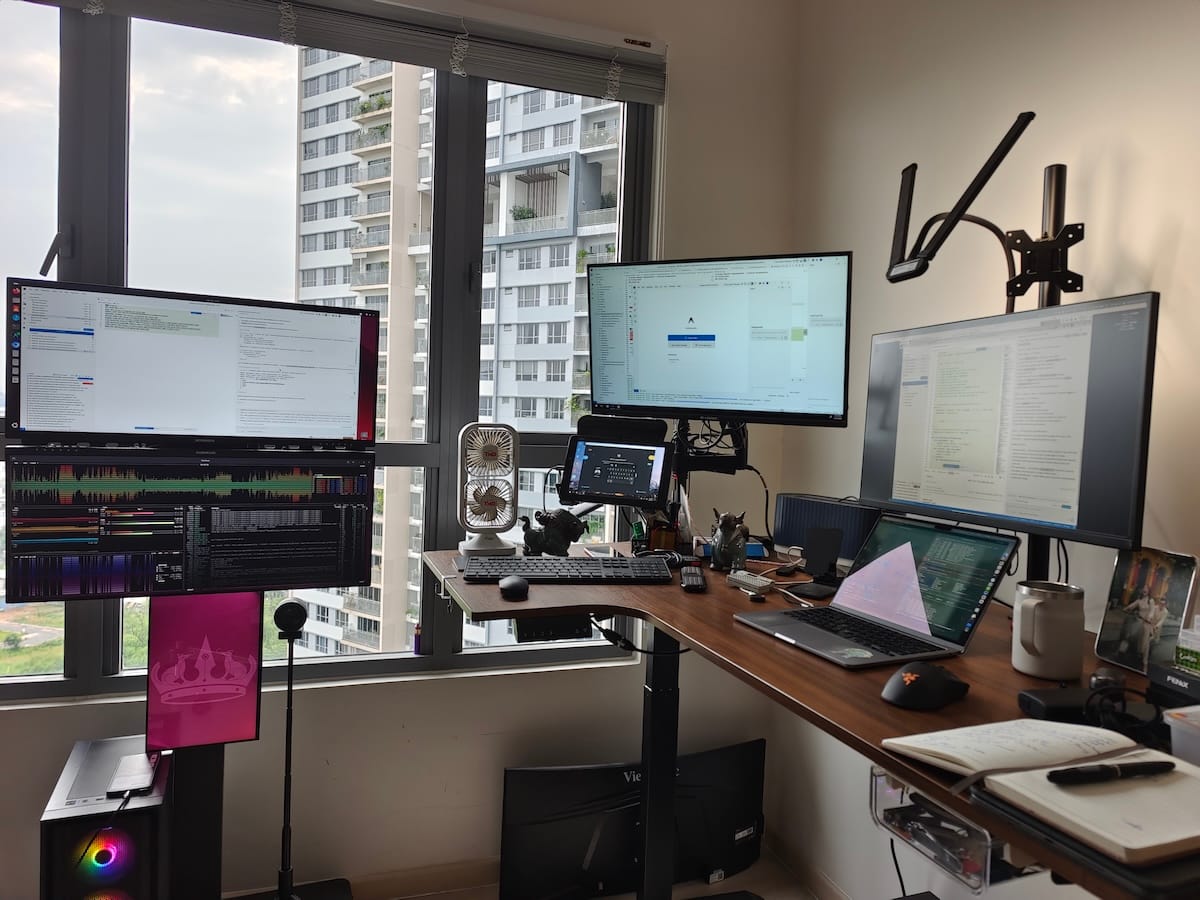
I'm going to share something that would have sounded insane two years ago: I now do the work that used to require a team of 20-25 engineers. Not as a thought experiment. As my daily reality.
From 2013 to 2024, I built hundreds of systems — ERPs for ride-hailing companies, eCommerce platforms, retail operations suites. My teams were the industry-standard "lean" setup:
- 1 Project Manager
- 1 Product Owner
- 1 Business Analyst
- 1 UI/UX Designer
- 1 Tech Lead
- 1-2 Backend Developers
- 1-2 Frontend Developers
- 1 Mobile Developer
- 1 Sysadmin/DevOps
- 2-3 QA/QC
That's 12-15 people minimum, often scaling to 20-25 for complex projects. Salaries, coordination overhead, standups, sprint planning, merge conflicts, communication breakdowns — the standard playbook.
Then, in early 2025, circumstances forced my hand. Cost pressures hit. I had to let go of my entire 5-6 person team. It was one of the hardest decisions I've made.
And then something unexpected happened: I discovered I could still build.
The New Stack: What $100/Month Actually Buys
Here's my exact monthly spend as of February 2026:
For non-coding tasks:
- Google AI Pro — $20 (shared across 5 family accounts: NotebookLM, Google AI Studio, Antigravity, Photos, storage)
- Grok / ChatGPT — free tiers
For coding tasks:
- Warp.dev Pro + custom Gemini API key — $18
- Claude Code with Z.AI plan (GLM 5 custom model) — $30
- Open Code with Kimi model — free
- Trae.ai — $6 (light IDE usage)
- Groq free tier — $0 (open-source models for specific code tasks)
Total: ~$74/month for technically unlimited AI-assisted development tokens. That includes video generation, audio generation, transcription — everything.
Meanwhile, I hear beginner devs paying $200-500/month for plans like Claude Max or Gemini Ultra. You don't need to.
What a Typical Day Looks Like
My current setup is... multiple screens. AI needs more tokens and more screens. That's just the reality.
On any given day, I might have:
- Antigravity running in the main IDE, writing and refactoring entire modules while I review the output
- Warp terminal with Gemini handling infrastructure tasks — deployments, database migrations, server configs
- Claude Code for deep architectural decisions where I need a second opinion on approaches
- NotebookLM consolidating research from past projects into actionable briefs
The key insight that took me months to internalise: the bottleneck is no longer writing code. It's providing context. I spend more time crafting precise prompts, curating reference documentation, and reviewing AI output than I spend typing code. The AI writes. I architect, review, and decide.
This is why the "one-person dev team" isn't actually about one person doing everything manually — it's about one person orchestrating AI tools that each handle a different layer of the stack.
What OpenClaw Proved to Everyone
When Peter Steinberger wrote the entire OpenClaw stack in a few weeks by himself, a lot of people were surprised. Then came MimiClaw, NanoClaw, TinyClaw, OpenClawPi — one person after another replicating what used to require teams.
But here's the thing: this isn't even difficult anymore. It's becoming the norm.
If you're still stuck with vanilla VSCode, or Codex, or base GitHub Copilot, chances are you're already outdated by a long shot. The tooling has moved past autocomplete into genuine agentic development — AI that doesn't just suggest the next line, but plans, implements, tests, and iterates on entire features.
The Part Nobody Talks About: What Gets Harder
I'd be dishonest if I said this transition was painless. Some things genuinely get harder when you're solo:
Decision fatigue is real. When you have a team, decisions get debated. When you're alone, every architectural choice is yours. AI can propose options, but the judgment call — "should we use SQLite or Postgres for this use case?" — that's still entirely on you. And the decisions add up.
Context switching is brutal. In a team, the frontend dev and the backend dev work in parallel. Solo, you're switching between Svelte components, API endpoints, database schemas, and DevOps configs — sometimes within the same hour. The mental cost is significant.
Quality assurance needs discipline. Without a dedicated QA person, you have to build the testing habit into your workflow, not bolt it on later. I write tests before I write features now, which I never consistently did when I had a QA team.
Loneliness. Let's be honest about it. Rubber-ducking with an AI isn't the same as having a colleague who understands your codebase history, your deployment quirks, your client's personality. I miss that.
Where This Is Going
The software development landscape is splitting into two tracks:
Track 1: Large organisations will still have teams, but those teams will be dramatically smaller and structured differently. The ratio of "AI-augmented builders" to "traditional developers" will shift fast. A team of 5 AI-augmented engineers will outpace a team of 20 traditional developers on most projects.
Track 2: Solo builders and micro-teams will become the norm for startups, SMEs, and internal tools. One founder-developer with the right AI stack will ship products that used to require seed funding and a 10-person team.
I'm not saying developers should fear AI. I've been saying this to Vietnamese dev communities for months: AI is the Iron Man suit you've been waiting for. If you still have passion for code, this is the best time to be a developer. If you don't have passion, well — that's a separate conversation.
The Current Setup at Alpha Bits
Here's what my ideal project team looks like in 2026:
- 1 × Project Manager
- 1 × Fullstack Developer
- 1 × QA/QC
Three humans. Multiple AI agents handling everything in between. The same calibre of complex ERP systems that used to need 20+ people.
Software isn't expensive to build anymore. The expensive part is knowing what to build — and that's still, thankfully, a human skill.
We're building our tools and workflows in public. Follow our updates on the Alpha Bits blog and our GitHub.