The I.C.E. (Integrated Cold Energy) Battery started as a "contingency plan-Z": a theoretical pivot during a difficult period. It turned into something real enough to be accepted into NUS Enterprise BLOCK71 at Singapore Science Park in June 2025.
The goal is affordable cold energy storage for Singapore's HDB public housing, where air conditioning makes up a large part of household energy costs.
From heat to cold
After our 2022 sand battery experiment and the US patent that followed, one question kept nagging me: if we can store thermal energy as heat with 98% efficiency, why not store it as cold?
Most of us think of thermal energy as something we consume directly, burning fuel for heat or running air conditioners for cooling. I wanted to capture and store it at both ends of the temperature range.

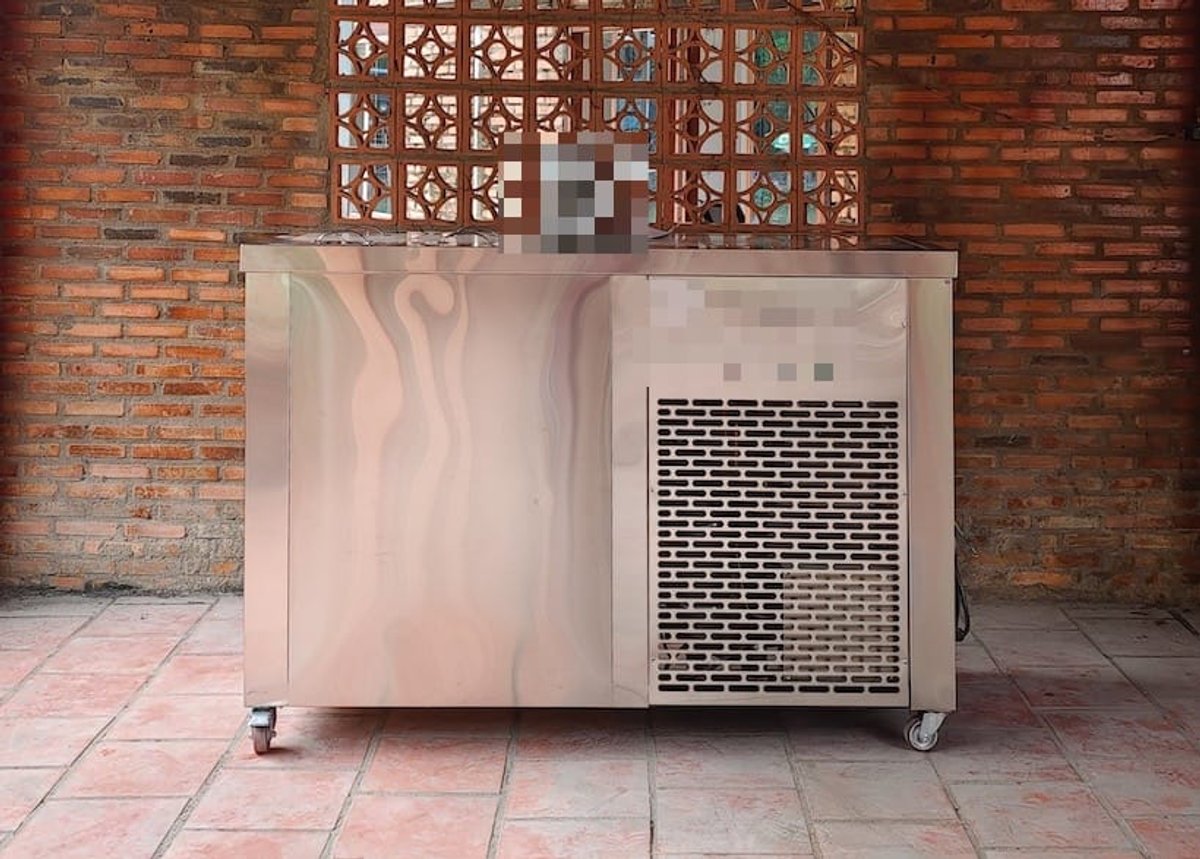
Sand Battery Prototype #0 next to I.C.E. Battery Prototype #0, the hot and cold ends of thermal storage
Why cooling demand matters
The International Energy Agency projects that energy demand for space cooling could triple by 2050. We already see the loop in Southeast Asia: as temperatures rise, more people buy air conditioners, those air conditioners use more electricity (often from fossil fuels), and that adds to the warming that drives demand for cooling.
In Singapore it's 30°C or more year-round and HDB flats house 80% of the population, so air conditioning is a health necessity rather than a luxury. It's also expensive.
How a contingency became a company
In November 2024, as problems with our original thermal storage work got worse, what I'd treated as a theoretical exploration became a practical lifeline. I bought the domain thermion.energy, partly as a strategic move and partly on faith that thermal energy technology had a future beyond heat storage.
The technical idea is that "storing cold" really means removing heat and keeping it out. Conventional cooling systems draw energy the whole time they run. The I.C.E. Battery charges during off-peak hours, using cheap and often renewable electricity to chill a storage medium to -22°C (-7.6°F) or lower, and then delivers cooling passively when it's needed. There's no compressor running continuously and no peak-hour electricity bill, just stored cold released through a heat exchanger.

I.C.E. Battery Prototype #1, the industrial-scale pilot at Bien Hoa Farm, January 2025
The Bien Hoa farm pilot
Our first real-world test was at a farm facility in Bien Hoa, outside Ho Chi Minh City. The application was agricultural cooling: keeping temperature-sensitive crops at a steady temperature and providing cold storage for harvested produce.
Monitoring runs on the same HomeLab stack we use for everything else: Raspberry Pis, Node-RED, MQTT sensors, ZeroTier for networking between sites, and Cloudflare Tunnel for remote access. A single Pi in the facility handles over 10,000 data points a day, covering temperature, humidity, energy consumption and system health.
Where it goes next
Beyond agriculture, these are the applications we're most interested in:
- Cold chain logistics, with zero-emission refrigerated storage and transport replacing diesel-powered units
- Off-grid cooling, with solar-powered I.C.E. Battery systems for places with unreliable grid access
- HDB housing, the original Singapore idea: affordable cooling for public housing units, charged overnight
Charging off-peak and delivering cooling at peak demand cuts electricity costs by 40-60%. The systems use water-based thermal storage instead of harmful refrigerants, and with a 20+ year operational lifespan, replacement costs stay near zero.
Our companion post has the full technical breakdown: the three-stage process, the IoT architecture and the sensor specifications.
What started as plan-Z is now the plan. I keep relearning that good ideas don't always look like good ideas at first.