After our post on how a 2022 balcony experiment started our AIoT work, many readers asked how sand batteries work in more technical detail. This guide covers the science and engineering behind thermal energy storage.
If you'd like to explore the physics interactively first, we built a sand battery thermal simulation with an all-AI team: NotebookLM for research, Google Stitch for UI design and Antigravity for code. It took a few hours rather than a few weeks.
What a sand battery is
A sand battery is a thermal energy storage system that holds heat in sand at 300°C (572°F) and above. A conventional battery stores electrical energy through chemical reactions. A sand battery stores heat in the sand itself, using the physical properties of the heated particles.
You convert electricity into heat, store that heat in an insulated container of sand, and release it when you need it. The conversion from electricity to heat is 98% efficient, and with proper insulation the thermal mass of the sand holds the energy for 24+ hours.

The original sand battery prototype from December 2022, where thermal energy storage met IoT monitoring
The three-stage process
Stage 1: charging, or converting electricity to heat
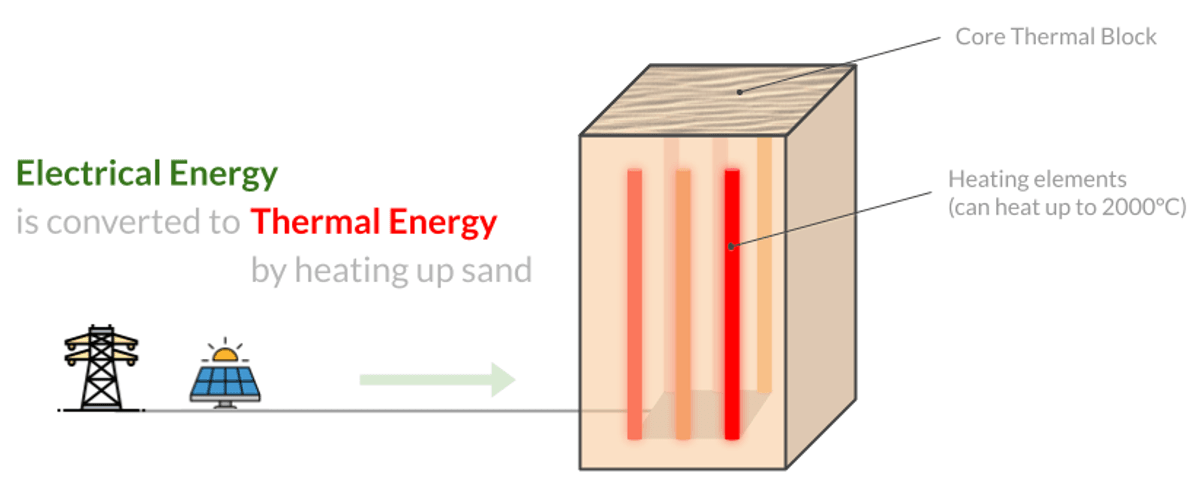
Resistive heating elements convert electrical energy to heat at 98% efficiency. They are similar to the elements in an electric oven but built for much higher temperatures (rated up to 2,000°C). The other 2% is lost in wiring and connections.
The electricity can come from solar panels, the grid or wind. In practice, charging overnight on off-peak rates makes the most economic sense.
During charging, IoT temperature sensors track the heating continuously, automated shutoffs prevent overheating, and the heating rate is controlled so heat spreads evenly through the sand.
Stage 2: storage, or keeping the heat in
This is the hardest engineering problem. Holding 300-600°C inside the container while the outside stays at room temperature takes several layers of insulation:
- Fiberglass as the primary thermal barrier
- Ceramic wool for high-temperature resistance
- Vacuum seal panels to keep heat loss to a minimum
- Reflective barriers that send radiant heat back into the core
How long the stored energy stays usable depends directly on the insulation. In our 2022 prototype, insulation degradation was the first thing our IoT sensors caught. Temperature drops that didn't match the model told us exactly where heat was escaping.

Electricity-to-thermal energy conversion at 98% efficiency
Stage 3: discharging, or releasing the heat
Metal tubes run through the sand. When heat is needed, fans push ambient air through the tubes, and the air picks up heat from the sand and comes out hot at the other end.
The discharge process is entirely passive, with no combustion, no chemical reactions and zero emissions. Fan speed sets how much heat is delivered, and the large thermal mass gives steady output for 24+ hours per charge cycle.
Why sand works
Sand is an unglamorous material, but it's close to ideal for this job. It has excellent heat retention over long periods. It's cheap: abundant, available locally in most regions, and it needs little processing. Chemical batteries degrade over charge cycles, while sand keeps its thermal properties indefinitely; the only consumable parts are the heating elements, which are cheap to replace. It's also safe, with no toxic materials and no fire risk from the storage medium itself, and it is fully recyclable.
Desert sand, with its small, round, high-density particles, performs best.
The economics
Sand batteries cut energy costs in a simple way. You charge during off-peak hours when electricity is cheapest (typically overnight) and discharge during peak hours, when you would normally pay the highest rates.
From our deployments:
- 30-50% lower heating costs from time-of-use optimisation
- Minimal maintenance, with no battery management system and no regular component replacement
- An operational lifespan of 20+ years, because the sand doesn't wear out
- A payback period of 3-7 years, depending on local electricity prices and usage patterns
The upfront cost per kWh of storage is much lower than for lithium-ion battery storage. The trade-off is that a sand battery stores only heat, not electricity.
IoT integration
Sand battery installations benefit a great deal from continuous monitoring, as our 2022 experiment showed early on. Temperature sensors throughout the sand, insulation degradation detection and energy flow tracking let us optimise the charging schedule automatically.
We use Node-RED for flow orchestration, InfluxDB for time-series data and Grafana for dashboards, the same stack that runs all our IoT deployments. The monitoring runs on Raspberry Pis in our HomeLab.
| Metric | Performance |
|---|
| Charging Efficiency | 98% |
| Storage Duration | 24+ hours |
| Operating Temperature | 300-600°C |
| System Lifespan | 20+ years |
| Maintenance | Minimal |
The technology scales from residential hot water systems to industrial district heating. The core method stays the same whether you're on a balcony in Saigon or a factory floor in Finland: heat the sand, insulate it well and extract the heat when you need it.

Commercial-scale sand battery installation in Finland