This follows our I.C.E. Battery origin story and covers the engineering: how cold energy storage works, and how we monitor installations with the same HomeLab infrastructure that runs our other projects.
The core principle: you can't store cold
The first thing to understand about the I.C.E. Battery sounds backwards. You cannot "store cold," because cold is just the absence of heat. The system uses electrical energy to remove a large amount of heat from a storage medium, which leaves a reservoir of low-temperature potential energy.
It works like pumping water uphill to store gravitational potential energy. We use electricity to "pump" heat out of the storage medium and drop its temperature to -22°C (-7.6°F) or lower. That stored thermal potential can then absorb heat from its surroundings on demand and provide cooling for a long stretch.

Cold energy storage in its simplest form: a frozen storage medium at 0°C or lower inside the I.C.E. Battery tank
The three-stage process
Stage 1: charging
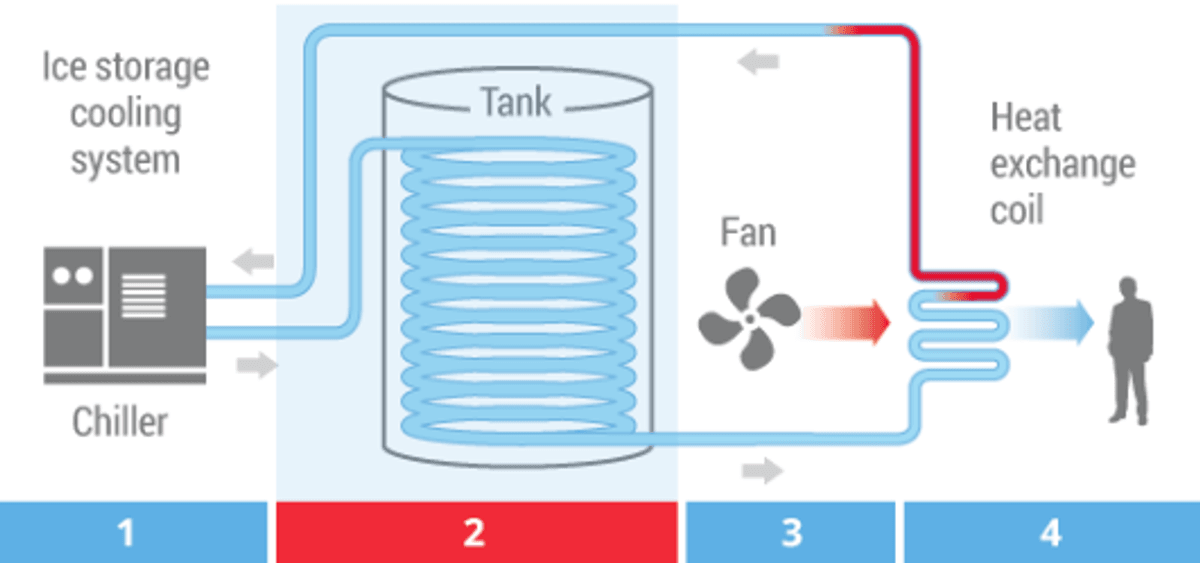
During charging, electricity powers efficient chillers that pull heat out of the storage core. Water containing 25% ethylene or propylene glycol circulates through heat exchangers and brings the medium down to -22°C or below.
The battery usually charges overnight, when electricity rates are lowest and ambient temperatures are cooler. It can run on solar, wind or grid electricity. Charging is intensive during off-peak hours, and once it finishes, the main energy input for the cycle is done.
A charged battery holds its thermal potential for 24+ hours. The energy is in the system, so it needs no continuous power draw.
Stage 2: storage
Holding the cold is the hardest engineering problem. It's the same problem as our sand battery's heat storage, in reverse. Keeping -22°C inside while it's 35°C outside (typical Saigon conditions) takes serious insulation:
- Multi-layer vacuum-sealed panels with reflective barriers
- No thermal bridges, meaning no conductive path from the outside to the core
- Phase change materials for extra thermal buffering in critical temperature ranges
- IoT sensors that monitor insulation performance in real time (this is where we catch degradation before it turns into efficiency loss)
Stage 3: discharging
When cooling is needed, a heat transfer medium circulates through heat exchangers built into the cold storage core. That medium is air for space cooling or liquid coolant for refrigeration. The warmer medium gives up its heat to the cold storage material and comes out chilled.
Discharge is passive. No compressor runs and there is no high-power electricity draw; fan speeds and flow rates set how much cooling is delivered. The large thermal mass gives steady output, with consistent cooling for 24+ hours per charge cycle.

Daytime cooling delivery: glycol solution circulates through ice storage tanks during peak hours
How we monitor installations
Our I.C.E. Battery installations use the same monitoring stack we run for everything at Alpha Bits: open-source tools on Raspberry Pis, with no proprietary platform.
Node-RED handles orchestration. It collects sensor data, runs the automation logic, triggers alerts and manages charging schedules.
MQTT carries publish-subscribe messages between the sensors and the control system. It uses little bandwidth, which matters for remote installations with spotty internet. It also gives us guaranteed delivery for control commands and sub-second response times.
ZeroTier connects the locations. Our Saigon headquarters, the Bien Hoa farm facility and remote installation sites all sit on the same virtual network. To add a monitoring node, we install ZeroTier and join the network. There's no per-site VPN configuration and no port forwarding.
Cloudflare Tunnel gives us secure remote access to the dashboards without exposing any ports. It's zero-trust access with no inbound firewall rules.
What the sensors track
Each installation runs several kinds of sensors.
Thermal sensors measure core temperature at several points in the storage medium, surface temperature (to check insulation performance), ambient conditions, and the inlet/outlet difference across each heat exchanger.
Energy sensors track power consumption during charging, delivered cooling capacity, real-time coefficient of performance (COP), and flow rates for the heat transfer medium.
System health sensors cover vibration (to catch mechanical issues early), pressure (for leak detection) and the chemical composition of the heat transfer fluid.
Each installation produces over 10,000 data points a day. We store them in InfluxDB and view them in Grafana dashboards.
Performance
| Metric | Specification |
|---|
| Storage temperature | -22°C (-7.6°F) or lower |
| Cooling duration | 24+ hours per charge |
| Energy cost reduction | 40-60% (off-peak charging) |
| System lifespan | 20+ years |
| Monitoring data points | 10,000+ per day per system |
| Remote access latency | <100ms via Cloudflare Tunnel |
The 40-60% cost reduction comes from a simple mechanism. The system charges when electricity is cheapest (overnight, or when solar is producing excess) and delivers cooling when it's most expensive (the afternoon demand peak). This peak-shaving also helps utility companies, and our systems can take part in demand response programmes.
The 20+ year lifespan is possible because the storage medium itself doesn't degrade. Because the storage is water-based rather than chemical refrigerant, the storage material carries no ozone depletion risk and has no global warming potential.