Two years ago this would have sounded insane: I now do the work that used to take a team of 20-25 engineers, and I do it every day.
From 2013 to 2024 I built hundreds of systems, including ERPs for ride-hailing companies, eCommerce platforms and retail operations suites. My teams followed the industry-standard "lean" setup:
- 1 Project Manager
- 1 Product Owner
- 1 Business Analyst
- 1 UI/UX Designer
- 1 Tech Lead
- 1-2 Backend Developers
- 1-2 Frontend Developers
- 1 Mobile Developer
- 1 Sysadmin/DevOps
- 2-3 QA/QC
That's 12-15 people at minimum, often growing to 20-25 for complex projects. It came with the usual salaries, coordination overhead, standups, sprint planning, merge conflicts and communication breakdowns.
In early 2025, cost pressures forced my hand and I had to let go of my entire 5-6 person team. It was one of the hardest decisions I've made.
What I didn't expect was to find that I could still build.
The new stack: what $100/month buys
This is my exact monthly spend as of February 2026.
For non-coding tasks:
- Google AI Pro: $20 (shared across 5 family accounts, covering NotebookLM, Google AI Studio, Antigravity, Photos and storage)
- Grok / ChatGPT: free tiers
For coding tasks:
- Warp.dev Pro + custom Gemini API key: $18
- Claude Code with Z.AI plan (GLM 5 custom model): $30
- Open Code with Kimi model: free
- Trae.ai: $6 (light IDE usage)
- Groq free tier: $0 (open-source models for specific code tasks)
Total: ~$74/month for technically unlimited AI-assisted development tokens. That includes video generation, audio generation and transcription.
Meanwhile I hear of beginner devs paying $200-500/month for plans like Claude Max or Gemini Ultra. You don't need to.
What a typical day looks like
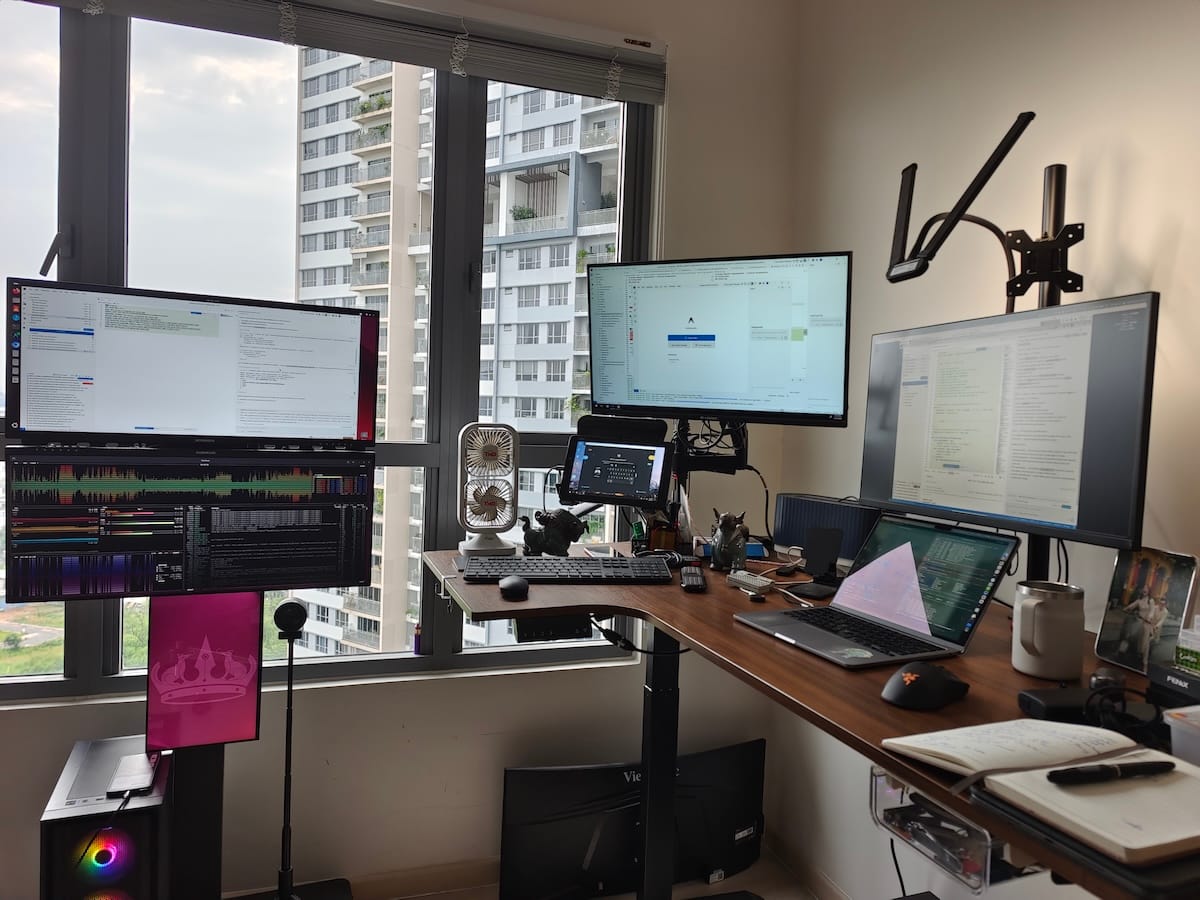
My current setup is multiple screens. AI needs more tokens and more screens, and I've stopped fighting that.
On any given day I might have Antigravity running in the main IDE, writing and refactoring entire modules while I review the output. Warp terminal with Gemini handles infrastructure work such as deployments, database migrations and server configs. I use Claude Code for deep architectural decisions where I want a second opinion on an approach, and NotebookLM to pull research from past projects into briefs I can act on.
It took me months to accept that writing code is no longer the bottleneck. Providing context is. I spend more time writing precise prompts, curating reference documentation and reviewing AI output than I spend typing code. The AI writes, and I design the architecture, review and decide.
So a "one-person dev team" doesn't mean one person doing everything by hand. It means one person orchestrating AI tools, each handling a different layer of the stack.
What OpenClaw proved to everyone
When Peter Steinberger wrote the entire OpenClaw stack by himself in a few weeks, a lot of people were surprised. Then came MimiClaw, NanoClaw, TinyClaw and OpenClawPi, one person after another building what used to take a team.
This is no longer difficult, and it's becoming normal.
If you're still on vanilla VSCode, Codex or base GitHub Copilot, you're probably well behind already. The tooling has moved past autocomplete into agentic development, where the AI plans, implements, tests and iterates on whole features instead of suggesting the next line.
What gets harder
This transition was not painless, and some things really are harder when you work solo.
Decision fatigue is real. On a team, decisions get debated. Alone, every architectural choice is yours. AI can propose options, but the judgment call ("should we use SQLite or Postgres for this use case?") is still entirely on you, and those calls add up.
Context switching is brutal. On a team, the frontend dev and the backend dev work in parallel. Solo, I switch between Svelte components, API endpoints, database schemas and DevOps configs, sometimes within the same hour, and that costs a lot of mental energy.
Quality assurance takes discipline. Without a dedicated QA person, testing has to be built into the workflow from the start rather than bolted on later. I now write tests before I write features, which I never did consistently when I had a QA team.
And it gets lonely. Rubber-ducking with an AI isn't the same as having a colleague who knows your codebase history, your deployment quirks and your client's personality. I miss that.
Where this is going
I think software development is splitting into two tracks.
Large organisations will still have teams, but those teams will be much smaller and structured differently. The ratio of AI-augmented builders to traditional developers will shift fast, and a team of 5 AI-augmented engineers will outpace a team of 20 traditional developers on most projects.
For startups, SMEs and internal tools, solo builders and micro-teams will become the norm. One founder-developer with the right AI stack will ship products that used to need seed funding and a 10-person team.
Developers shouldn't fear AI. I've been telling Vietnamese dev communities for months that AI is the Iron Man suit you've been waiting for. If you still have a passion for code, this is the best time to be a developer. If you don't, that's a separate conversation.
The current setup at Alpha Bits
My ideal project team in 2026 looks like this:
- 1 × Project Manager
- 1 × Fullstack Developer
- 1 × QA/QC
That's three humans, with multiple AI agents handling everything in between, building the same kind of complex ERP systems that used to need 20+ people.
Software isn't expensive to build anymore. The expensive part is knowing what to build, and that is still a human skill.
We're building our tools and workflows in public. Follow our updates on the Alpha Bits blog and our GitHub.