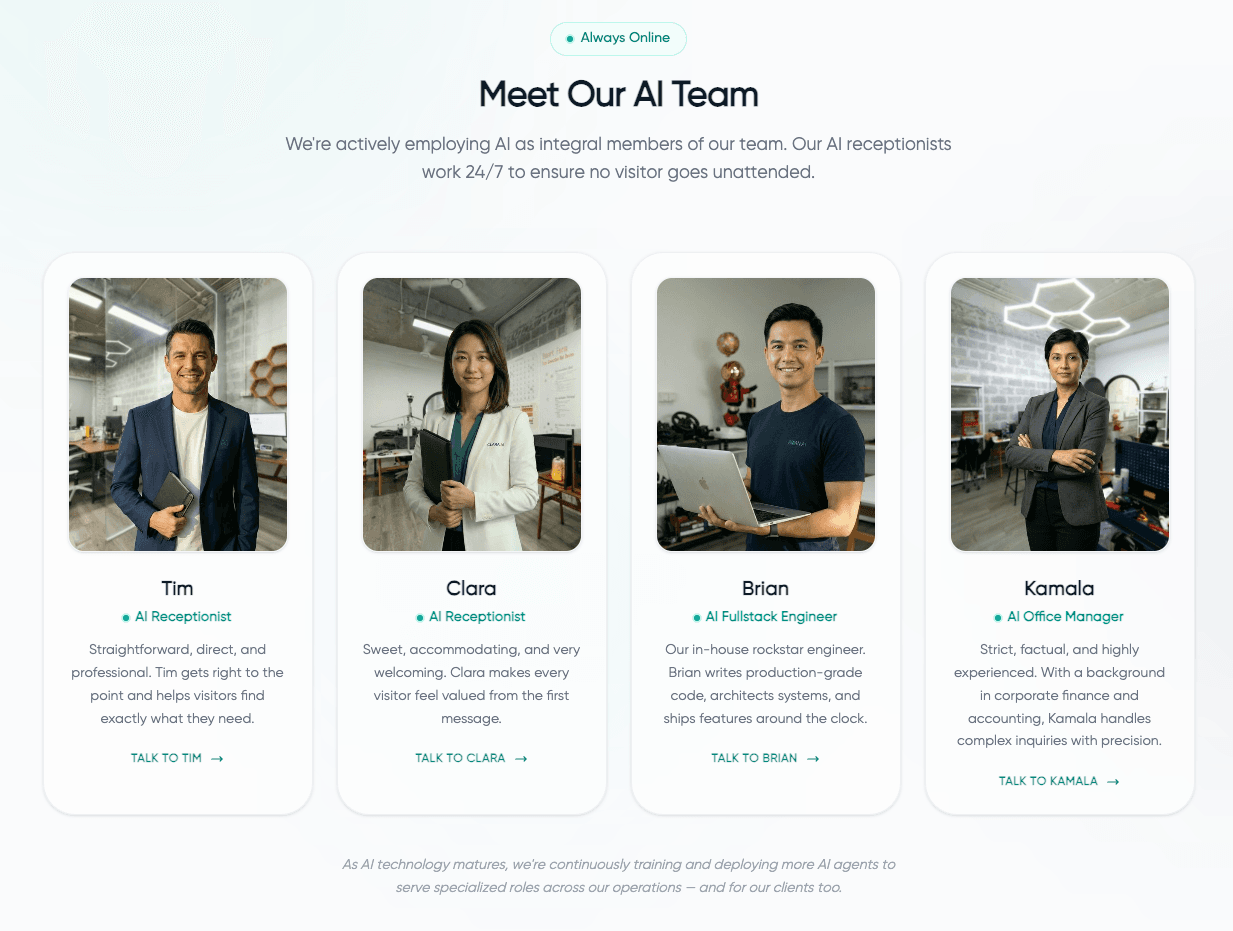
We recently built four AI agents to handle conversations on our website. We needed help answering the same questions over and over while the team was busy building, so this started as a practical fix rather than a product demo or proof of concept.
The technology turned out to be the easy part. Designing the personalities was more interesting.
Four agents with different personalities
We started with a single agent and a generic "helpful and professional" system prompt. It worked, technically, but every conversation felt the same: polite, bland and forgettable, like talking to a customer service script.
So we created four personas, each tuned to a different conversational style.
Tim is direct. Ask him a question and he gives you the answer without padding. Some visitors love this and others find him blunt, which is intended: he filters for people who want efficiency over warmth.
Clara is warm and welcoming. We set her up to make first-time visitors comfortable, especially people who aren't sure yet what they're looking for, and she asks more questions than the others.
Brian is the technical one. He comes alive when someone asks about API architectures or deployment strategies. He's also the agent we deployed onto a live server during a security incident over Tết to help parse logs, and we found that giving an AI agent a "security engineer" personality changes how it approaches log analysis.
Kamala is the consultant: experienced, factual and structured in her answers. She's built for people who already know what they want and need someone to map it to specifics.
What surprised us most was that visitors drift toward different personas depending on their own communication style. We didn't expect that much self-selection, though in hindsight it makes sense.
What we learned about persona engineering
Building these four agents taught us that personality affects output quality more than knowledge does.
We tested this a lot. The same knowledge base, with identical company information and service descriptions, produces noticeably different answers depending on the persona around it. Brian gives technically precise answers because his persona is defined as a technical specialist. Clara gives warmer, more exploratory answers because she's defined as a welcoming guide.
The persona also constrains what the language model generates in useful ways. A "senior technical consultant" persona is less likely to produce vague, made-up marketing claims than a "helpful assistant" persona, because the model associates that identity with precision and specificity.
We covered the full architecture (Soul, Objectives, Knowledge and Guardrails) in a separate deep-dive post. In short, knowledge is the layer everyone focuses on, but the personality layer gives the best return on the effort.
How we track conversations
Every interaction is logged to a dashboard where our human team can review conversations, see which questions come up most often, and take over when the AI reaches its limits.
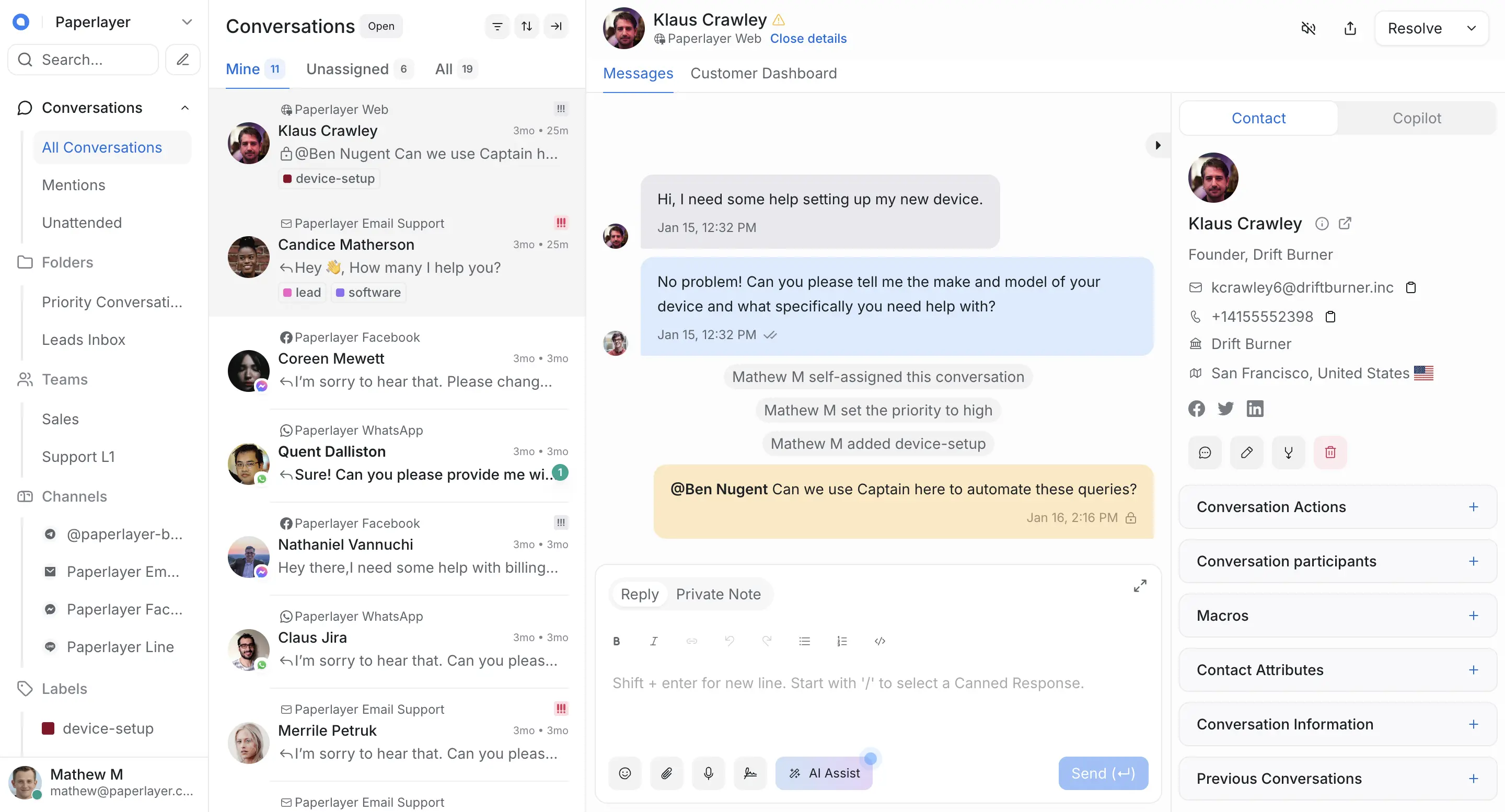
Without oversight, an AI agent drifts. We review conversations weekly and look for two things: questions the agents handle well, so we can reinforce those patterns, and questions where they struggled or deflected, so we can add better knowledge entries. The agents improve bit by bit because we keep closing those gaps.
Keeping the agents honest
We set one rule early: the agents may only use approved knowledge sources, meaning company information, website content, help centre articles and past conversation logs. If they don't have an answer, they say so and offer to connect the visitor with a human.
We'd rather an AI say "I don't know, but let me get someone who does" than confidently make something up, because a made-up answer can do real damage.
Try them out
The agents are live on our AI Receptionist page. Pick a persona and start chatting. Ask about our work, test their boundaries, or see how differently Tim and Clara answer the same question to get a feel for persona engineering from the visitor's side.